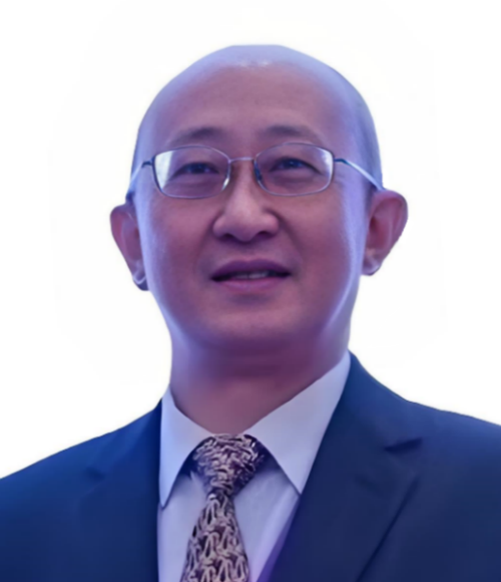
Prof. Honggang ZHANG, Macau University of Science and Technology (MUST), Macau, China, IEEE Fellow
Title: Agentic AI, NetGPT, AI-RAN, and Future 6G
Abstract: Large language model (LLM)-enabled agentic AI has triggered tremendous interests to empower information generation, processing, and inference. Towards personalized generative AI agent applications, agentic cloud-edge-terminal networking collaboration is a promising approach, since it facilitates the effective ubiquitous orchestration of heterogeneous communication, computing and control resources among the widely distributed AI agents. Accordingly, rooted in LLM-based agentic AI mechanisms and models, this talk will address the cutting-edge topic on how to inject agentic AI capability into the next-generation communication & computing networks and achieve future AI-native 6G networks. Particularly, NetGPT (i.e., networked GPT) will be focused as a foundation model of all networked LLMs for end-to-end approach (cloud-network-agents). In concrete, this talk includes the following key contents: (1) agentic AI system development, networked AI agents, and NetGPT environment for 6G; (2) recent research advancement in NetGPT-based network of agents, covering MCP (Model Context Protocol) and A2A (Agent-to-Agent) protocols; (3) discussions on the vision, architecture, and key technologies of AI-RAN.
Bio: Honggang Zhang (IEEE Fellow, AAIS/AAIA Fellow) is a Full Professor with the School of Computer Science and Engineering, Macau University of Science and Technology (MUST), Macau, China. He received the Ph.D. degree from Kagoshima University, Japan, in 1999. Previously, he was a Professor with the Faculty of Data Science, City University of Macau, as well as a Professor with the College of Information Science and Electronic Engineering, Zhejiang University, China. He was an Honorary Visiting Professor with the University of York, U.K., and an International Chair Professor of Excellence with the Université Européenne de Bretagne (UEB) and Supélec, France. He has co-authored and co-edited two books: Cognitive Communications: Distributed Artificial Intelligence (DAI), Regulatory Policy & Economics, Implementation (Wiley) and Green Communications: Theoretical Fundamentals, Algorithms and Applications (CRC Press). His research interests include cognitive radio networks, artificial intelligence, semantic communications, green communications, intelligent computing, and Internet of Intelligence (IoI). He was a co-recipient of the 2021 IEEE Communications Society Outstanding Paper Award and the 2021 IEEE Internet of Things Journal Best Paper Award. He was the leading Guest Editor for the Special Issues on Green Communications of IEEE Communications Magazine. He served as a Series Editor for IEEE Communications Magazine (Green Communications and Computing Networks Series) from 2015 to 2018 and the Chair of the Technical Committee on Cognitive Networks of IEEE Communications Society from 2011 to 2012. He was the founding Chief Managing Editor of Intelligent Computing, a Science Partner Journal (2022-2024). He is the Associate Editor-in-Chief of China Communications.